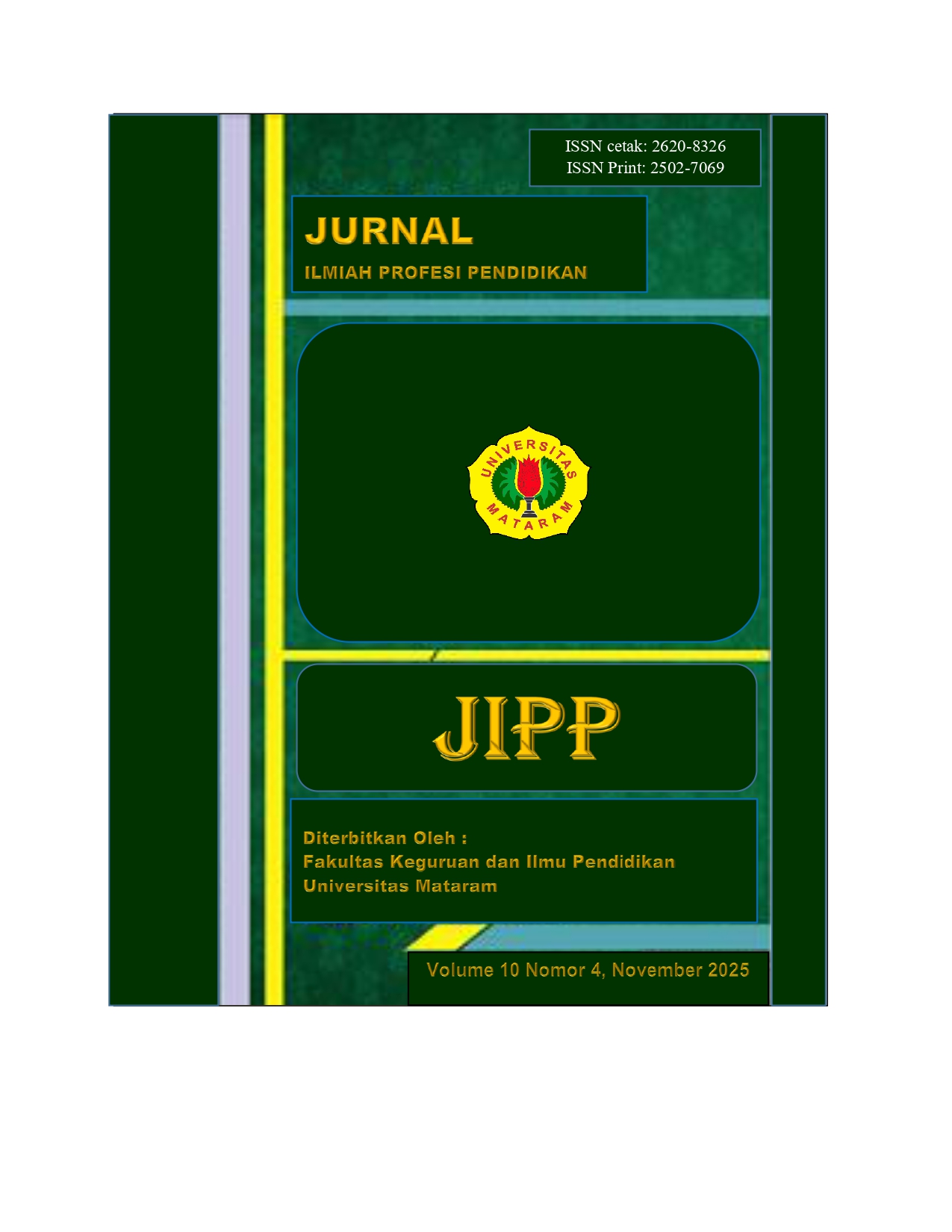
Project-Based Blended Learning Model: Innovative Solution to Improve Stiudents’ Scientific Article Writing Skills
DOI:
10.29303/jipp.v10i4.3451Published:
2025-10-26Downloads
Abstract
Scientific writing skills are essential for students in higher education, particularly in preparing them to contribute to academic publications. However, many students still face difficulties in composing scientific articles that meet academic standards. This study aims to develop a Project-based Blended Learning (PjB2L) model to improve the ability of IAIN Ambon students to write scientific articles. The research employed a Research and Development (R&D) approach using the ADDIE model, which consists of five stages: analysis, design, development, implementation, and evaluation. The participants were 24 students from Mathematics Education, PGMI, and MPI study programs who had previously conducted research. Data were collected through a media validity questionnaire, a scientific article writing ability test, and a scientific article writing rubric. The results indicate that the developed PjB2L model is both valid and effective in enhancing students’ scientific writing skills, as evidenced by a significant increase in pretest and posttest scores after the learning intervention. In conclusion, the PjB2L model serves as a viable alternative learning approach that leverages information and communication technology (ICT) to facilitate both independent and collaborative learning in scientific writing.
Keywords:
ADDIE model, Project-based Blended Learning (PjB2L), Scientific writing.References
An Nisa, K. (2018). Problem based learning dalam meningkatkan kemampuan menulis karya ilmiah mahasiswa. Jurnal Petik, 2(1), 24–31. https://doi.org/10.31980/jpetik.v2i1.63
Borg, W. R., & Gall, M. D. (1983). Educational research: An introduction (4th ed.). Longman.
Branch, R. M. (2009). Instructional design: The ADDIE approach. Springer.
Burhannuddin. (2021). Efektivitas penerapan model pembelajaran blended learning terhadap kemampuan menulis artikel ilmiah. Jurnal Pendidikan, 20(2), 1280–1287. https://doi.org/10.30863/ekspose.v20i2.1386
Gunawan, J., Jufri, A. W., Sedijani, P., Hadiprayitno, G., & Bachtiar, I. (2019). Pelatihan penulisan pada jurnal internasional bagi dosen dan mahasiswa magister pendidikan IPA Unram. Jurnal Pendidikan dan Pengabdian Masyarakat, 2(4), 484–489. https://doi.org/10.29303/jppm.v2i4.1526
Juniarti, Y. (2019). Pentingnya keterampilan menulis akademik di perguruan tinggi. In Prosiding Sembadra Universitas Sriwijaya (Vol. 2, Issue 1, pp. xx–xx).
Parhusip, F., Windarto, A. P., Damanik, I. S., Irawan, E., Syahputra, I., Studi, P., & Informasi, S. (2021). Klasifikasi faktor penyebab rendahnya minat mahasiswa dalam menulis artikel ilmiah. Jurnal Pendidikan, 4(2), 134–141. https://doi.org/10.31598/jurnalresistor.v4i2.700
Permana, F. H., Chamisijatin, L., & Zaenab, S. (2021). Pengaruh model pembelajaran berbasis proyek terhadap kemampuan menulis. JINoP (Jurnal Inovasi Pembelajaran), 7(c), 209–216. https://doi.org/10.22219/jinop.v7i2.10353
Saman, A., & Ilham Bakhtiar, M. (n.d.). Karya tulis ilmiah bagi mahasiswa STKIP Andi Matappa Kabupaten Pangkep.
Septafi, G. (2021). Analisis kemampuan menulis artikel ilmiah mahasiswa pendidikan guru sekolah dasar angkatan 2019. Educational Technology Journal, 1(2), 1–16. https://doi.org/10.26740/etj.v1n2.p1-16
Sevima. (n.d.). 12 jenis blended learning dan contoh penerapannya. Retrieved September 17, 2022, from https://sevima.com/jenis-blended-learning/
Sutady, N. (n.d.). Manfaat menulis artikel ilmiah untuk dosen dan mahasiswa – Fakultas Ushuluddin. Retrieved September 12, 2022, from https://fu.uinsgd.ac.id/manfaat-menulis-artikel-ilmiah-untuk-dosen-dan-mahasiswa
License
Copyright (c) 2025 Djaffar Lessy, Dinar Riaddin, Qurrota A'yun

This work is licensed under a Creative Commons Attribution 4.0 International License.
 klik di sini