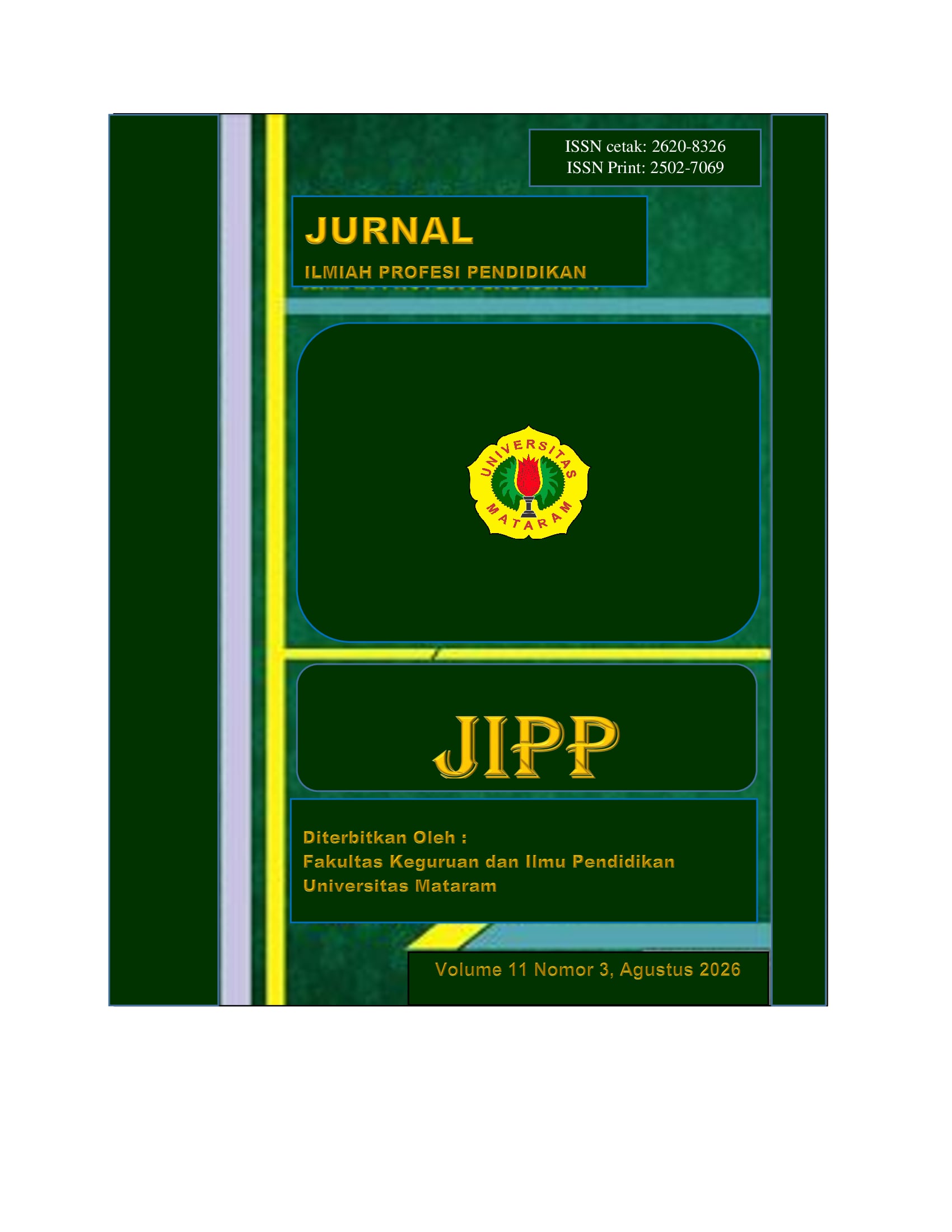
Pengembangan E-Book Kimia Berbasis STEAM untuk Materi Sifat Koligatif Larutan: Tinjauan Literatur Sistematis terhadap Peningkatan Kemampuan Berpikir Kritis dan Motivasi Belajar Siswa
DOI:
10.29303/jipp.v11i3.5324Published:
2026-08-19Downloads
Abstract
Transformasi pembelajaran abad ke-21 menuntut pengembangan bahan ajar digital yang tidak hanya meningkatkan penguasaan konsep, tetapi juga mengembangkan kemampuan berpikir kritis dan motivasi belajar siswa. Salah satu inovasi yang relevan adalah e-book kimia berbasis Science, Technology, Engineering, Arts, and Mathematics (STEAM), terutama pada materi sifat koligatif larutan yang bersifat abstrak dan memerlukan visualisasi konseptual. Penelitian ini bertujuan menganalisis tren penelitian, karakteristik pengembangan, implementasi, dan efektivitas e-book kimia berbasis STEAM dalam meningkatkan kemampuan berpikir kritis dan motivasi belajar siswa melalui pendekatan Systematic Literature Review (SLR). Kajian dilakukan berdasarkan pedoman Preferred Reporting Items for Systematic Reviews and Meta-Analyses (PRISMA) dengan menelusuri artikel yang dipublikasikan pada periode 2020–2025 melalui basis data Scopus, Web of Science, ScienceDirect, ERIC, dan Google Scholar. Sebanyak 30 artikel yang memenuhi kriteria inklusi dianalisis menggunakan sintesis tematik. Hasil kajian menunjukkan bahwa e-book berbasis STEAM mengintegrasikan multimedia interaktif, pembelajaran berbasis proyek, eksperimen virtual, pemecahan masalah kontekstual, dan asesmen autentik yang secara konsisten meningkatkan kemampuan berpikir kritis, motivasi belajar, keterlibatan, kreativitas, serta pemahaman konseptual siswa. Penelitian ini menyimpulkan bahwa e-book kimia berbasis STEAM merupakan inovasi pembelajaran yang efektif dan memiliki prospek strategis dalam mendukung pembelajaran kimia yang bermakna, berpusat pada peserta didik, dan berorientasi pada penguatan kompetensi abad ke-21.
Keywords:
Berpikir Kritis; E-book Kimia; Motivasi Belajar; Sifat Koligatif Larutan; STEAM.References
Amin, Z. M., Anwar, N., Mohd Shoid, M. S., & Samuri, S. (2022). Method for Conducting Systematic Literature Review (SLR) for Cyber Risk Assessment. Environment-Behaviour Proceedings Journal, 7(SI10), 255–260. https://doi.org/10.21834/ebpj.v7iSI10.4130
Athikarisamy, S., & Patole, S. (2021). Reporting of Meta-Analysis (PRISMA). In S. Patole (Ed.), Principles and Practice of Systematic Reviews and Meta-Analysis (pp. 111–123). Springer International Publishing. https://doi.org/10.1007/978-3-030-71921-0_11
Avcı, F., Özsoy-Güneş, Z., & Kırbaşlar, F. G. (2010). The study of the subjects distribution inorganic and organic chemistry in elementary and high school education curriculum. Procedia - Social and Behavioral Sciences, 2(2), 2616–2624. https://doi.org/10.1016/j.sbspro.2010.03.383
BeMiller, J. N. (2019). Polysaccharides. In Carbohydrate Chemistry for Food Scientists (pp. 75–101). Elsevier. https://doi.org/10.1016/B978-0-12-812069-9.00004-2
Budi, B., & Felix, S. (2024). Contemporary Financial Management. Systematic Literature Review (SLR). International Journal on Economics, Finance and Sustainable Development, 6(10), 253–259. https://doi.org/10.31149/ijefsd.v6i10.5324
Chen, X., Liu, J., Liu, Y., Xiang, H., Guo, X., Cai, X., & Wang, X. (2026). Can ChatGPT outperform college students in critical thinking skills during argumentation activities? A case study. Thinking Skills and Creativity, 61, 102166. https://doi.org/10.1016/j.tsc.2026.102166
Chenchen, W. (2026). Enhancing critical thinking and English writing skills: The impact of blended learning in college education. Thinking Skills and Creativity, 61, 102212. https://doi.org/10.1016/j.tsc.2026.102212
Deltete, R. J. (2012). Entropy in Chemistry. In Philosophy of Chemistry (pp. 495–506). Elsevier. https://doi.org/10.1016/B978-0-444-51675-6.50031-1
Dhlamini, J. (2026). Strategic planning bibliometric-systematic literature review (B-SLR) insights and future research agenda. Strategic Business Research, 2(1), 100069. https://doi.org/10.1016/j.sbr.2026.100069
Felizardo, K. R., Salleh, N., Martins, R. M., Mendes, E., MacDonell, S. G., & Maldonado, J. C. (2021). Using Visual Text Mining to Support the Study Selection Activity in Systematic Literature Reviews. https://doi.org/10.48550/ARXIV.2102.02934
Fuentes, A. (2022). Reseña de sitio web: Preferred Reporting Items for Systematic Reviews and Meta-Analyses (PRISMA). Declaración PRISMA 2020. Revista de Estudios e Investigación En Psicología y Educación, 9(2), 323–327. https://doi.org/10.17979/reipe.2022.9.2.9368
Furukado, R., Zhu, Y., & Hagiwara, G. (2024). Integrating Minecraft Education in Curriculum Design to Enhance Chemistry Learning. Procedia Computer Science, 246, 4375–4384. https://doi.org/10.1016/j.procs.2024.09.287
Grader-Beck, T., DiRenzo, D., Lalla, A., Takyar, S., Pandey, V., Chan, C., & Egana, A. (2026). Understanding The Humanistic Burden of Sjögren’s Disease (SJD): A Systematic Literature Review (SLR). Value in Health, 29(6), S380. https://doi.org/10.1016/j.jval.2026.03.1883
Hussein, M. T. E., Harvey, G., & Favell, D. (2025). Using exploratory sequential mixed methods design to develop simulation safety practice tool (SSPT). Clinical Simulation in Nursing, 101, 101704. https://doi.org/10.1016/j.ecns.2025.101704
Indinabila, Y., Kristiyono, J., Nasri, U., & Wulandari, E. R. (2026). Examining The Scholarly Literature on The Methods of Political Communication in Indonesia. Proceeding of Creative and Collaborative Communication Conference (CCOMM) 2025, 1(1). https://proceeding-ccomm.petra.ac.id/index.php/ccomm/article/view/92
Khamhaengpol, A., Nokaew, T., & Chuamchaitrakool, P. (2024). Development of STEAM activity “Eco-Friendly Straw” based science learning kit to examine students’ basic science process skills. Thinking Skills and Creativity, 53, 101618. https://doi.org/10.1016/j.tsc.2024.101618
Kharat, S., Nagarkar, S., & Panage, B. (2025). A systematic literature review (SLR) of circulation methods in academic libraries: Proposing QR codes for self-issue/return method. Global Knowledge, Memory and Communication, 74(3–4), 845–863. https://doi.org/10.1108/GKMC-08-2022-0188
Koskey, K. L. K., May, T. A., Fan, Y. “Kate”, Bright, D., Stone, G., Matney, G., & Bostic, J. D. (2023). Flip it: An exploratory (versus explanatory) sequential mixed methods design using Delphi and differential item functioning to evaluate item bias. Methods in Psychology, 8, 100117. https://doi.org/10.1016/j.metip.2023.100117
Krol, E. S., Velázquez-Martínez, C. A., Jurgens, T. M., & Albon, S. P. (2024). Medicinal chemistry curriculum and pedagogical practices at Canadian pharmacy schools: Towards standardization of practice. Currents in Pharmacy Teaching and Learning, 16(9), 102095. https://doi.org/10.1016/j.cptl.2024.04.011
Leiva, C., Torralvo, F. A., Luna-Galiano, Y., Ronda, A., & De La Peña Sequedo, D. M. (2025). Implementation of a continuous assessment system through the creation of a problem book using DOCTUS in general chemistry subjects. Education for Chemical Engineers, 53, 1–7. https://doi.org/10.1016/j.ece.2025.06.003
Liu, Z. (2021). Review and prospect of thermal analysis technology applied to study thermal properties of energetic materials. FirePhysChem, 1(3), 129–138. https://doi.org/10.1016/j.fpc.2021.05.002
López-Fernández, M. D. M., Cano-Iglesias, M. J., & Franco-Mariscal, A. J. (2025). Chemistry inquiry conducted by secondary school students into material degradation in the context of sustainability. RSC Sustainability, 3(9), 3997–4019. https://doi.org/10.1039/D5SU00176E
Lourenço, C. L. M. (2024). The Prisma 2020 Statement: An Instrument for The Appropriate Reporting of Systematic Reviews with Annotated Examples. https://doi.org/10.5281/ZENODO.13765704
Mazelfi, I., Luthan, L., & Ramadhan, Z. M. (2025). Systematic Literature Review (SLR): Explorasi Pembayaran Digital di Indonesia. Ensiklopedia of Journal, 7(4), 408–427. https://doi.org/10.33559/eoj.v7i4.3337
Melani, Y., Salahudin, S., Firdaus, M., & Sumitro, S. (2024). Human Rights Studies: A Systematic Literature Review (SLR). QISTINA: Jurnal Multidisiplin Indonesia, 3(1), 584–596. https://doi.org/10.57235/qistina.v3i1.2348
Muhali, & Asy’ari, M. (2026). Conceptual problem-based learning model: Promising intervention to enhance prospective science teachers’ critical thinking skills. Social Sciences & Humanities Open, 13, 102509. https://doi.org/10.1016/j.ssaho.2026.102509
Müller, J., & Lippert, B. (2023). Modern Avenues in Metal-Nucleic Acid Chemistry (1st edn). CRC Press. https://doi.org/10.1201/9781003270201
Nasri, U., Muliadi, E., & Rasyidi, A. H. (2024). Balancing Tradition and Modernity: Islamic Education in the Evolution of Wetu Telu in Northern Lombok. Jurnal Pendidikan Agama Islam (Journal of Islamic Education Studies), 12(2), 121–152.
Nurlatifah, S., Triwidyastuti, & Ahmar, N. (2025). Systematic Literature Review (SLR): ESG and Firm Value. Jurnal Akuntansi Dan Bisnis Krisnadwipayana, 12(2), 186–196. https://doi.org/10.35137/jabk.v12i2.466
Nzomo, C. M., Rugano, P., Njoroge, J. M., & Gitonga, C. M. (2023). Inquiry-based learning and students’ self-efficacy in Chemistry among secondary schools in Kenya. Heliyon, 9(1), e12672. https://doi.org/10.1016/j.heliyon.2022.e12672
O’Dea, R. E., Lagisz, M., Jennions, M. D., Koricheva, J., Noble, D. W. A., Parker, T. H., Gurevitch, J., Page, M. J., Stewart, G., Moher, D., & Nakagawa, S. (2021). Preferred reporting items for systematic reviews and meta‐analyses in ecology and evolutionary biology: A PRISMA extension. Biological Reviews, 96(5), 1695–1722. https://doi.org/10.1111/brv.12721
Page, M. J., McKenzie, J. E., Bossuyt, P. M., Boutron, I., Hoffmann, T. C., Mulrow, C. D., Shamseer, L., Tetzlaff, J. M., Akl, E. A., Brennan, S. E., Chou, R., Glanville, J., Grimshaw, J. M., Hróbjartsson, A., Lalu, M. M., Li, T., Loder, E. W., Mayo-Wilson, E., McDonald, S., … Moher, D. (2021a). Declaración PRISMA 2020: Una guía actualizada para la publicación de revisiones sistemáticas. Revista Española de Cardiología (English Edition), 74(9), 790–799. https://doi.org/10.1016/j.rec.2021.07.010
Page, M. J., McKenzie, J. E., Bossuyt, P. M., Boutron, I., Hoffmann, T. C., Mulrow, C. D., Shamseer, L., Tetzlaff, J. M., Akl, E. A., Brennan, S. E., Chou, R., Glanville, J., Grimshaw, J. M., Hróbjartsson, A., Lalu, M. M., Li, T., Loder, E. W., Mayo-Wilson, E., McDonald, S., … Moher, D. (2021b). The PRISMA 2020 statement: An updated guideline for reporting systematic reviews. BMJ, n71. https://doi.org/10.1136/bmj.n71
Page, M., McKenzie, J., Bossuyt, P., Boutron, I., Hoffman, T., Mulrow, C., Shamseer, L., Tetzlaff, L., Akl, E., Brennan, S., Chou, R., Glanville, J., Grimshaw, J., Hrobjartsson, A., Lalu, M., Li, T., Loder, E., Mayo-Wilson, E., McDonald, S., … Moher, D. (2024). Declaração PRISMA 2020: Uma Diretriz Atualizada para Publicação de Revisões Sistemáticas. https://doi.org/10.5281/ZENODO.13271468
Park, Y.-S., Mun, K., Hwang, Y., & Green, J. (2022). The Development of a STEAM Program about Global Energy with a Focus on Democratic Citizenship. Asia-Pacific Science Education, 8(1), 149–187. https://doi.org/10.1163/23641177-bja10044
Pichlak, M., Kaleta, K. J., & Nawacka, A. (2025). Systematic Literature Review Method in Legal Research: Prospects and Challenges. Law and Method. https://doi.org/10.5553/REM/.000085
Poya, Y. (2026). A sustainability approach to inquiry-based experiential chemistry education in pre-college programs. RSC Sustainability, 4(3), 1606–1614. https://doi.org/10.1039/D5SU00902B
Rafiki, A., Dana, L.-P., & Ong Hai Liaw, J. (2026). Entrepreneurial behavior in family business: Bibliometric – systematic literature reviews (B-SLR). Journal of Enterprising Communities: People and Places in the Global Economy, 20(1), 249–276. https://doi.org/10.1108/JEC-12-2023-0233
Riaño-Casallas, M., & Rojas-Berrío, S. (2023). How to Report Systematic Literature Reviews in Management Using SyReMa. Innovar, 34(92). https://doi.org/10.15446/innovar.v34n92.99156
Rum, A. M., & Juandi, D. (2022). Students’ Mathematical Literacy: Systematic Literature Review (SLR). Hipotenusa : Journal of Mathematical Society, 4(2), 148–164. https://doi.org/10.18326/hipotenusa.v4i2.8111
Saadi, P., Misbah, M., Arlinda, R., Muhammad, N., Harto, M., Qamariah, Q., & Haryandi, S. (2025). Wetland in science education: A systematic literature review (SLR). Journal of Advanced Sciences and Mathematics Education, 5(1), 181–196. https://doi.org/10.58524/jasme.v5i1.599
Salazar Ripoll, C. S., & Hincapié-Llanos, G. A. (2023). Evaluation of sources and methods of pectin extraction from fruit and Vegetable wastes: A Systematic Literature Review (SLR). Food Bioscience, 51, 102278. https://doi.org/10.1016/j.fbio.2022.102278
Singh, M., Azad, I., Qayyoom, M. A., & Khan, T. (2024). A study on perceptions and practices of STEAM-based education with university students. Social Sciences & Humanities Open, 10, 101162. https://doi.org/10.1016/j.ssaho.2024.101162
Singh, S., & Dash, A. K. (2024). Physical Properties, Their Determination, and Importance in Pharmaceutics. In Pharmaceutics (pp. 67–113). Elsevier. https://doi.org/10.1016/B978-0-323-99796-6.00002-3
Skoczkowski, T., Bielecki, S., Węglarz, A., & Gilewski, P. (2025). A mixed-methods evaluation of substitution fee design in White Certificate Systems: Evidence from Poland. Energy Reports, 14, 3346–3368. https://doi.org/10.1016/j.egyr.2025.10.024
Sukarelawan, A. G., Hamid, E. A., Qomusuddin, I. F., & Wemama, A. (2025). Determinants of Lecturer Performance: Systematic Literature Review (SLR) Approach. Al-Tanzim: Jurnal Manajemen Pendidikan Islam, 9(4), 1318–1337. https://doi.org/10.33650/al-tanzim.v9i4.11658
Suntharalingam, K. (2023). Modern Avenues in Metal-Nucleic Acid Chemistry. Inorganica Chimica Acta, 557, 121712. https://doi.org/10.1016/j.ica.2023.121712
Surya Rizaldi, & Rijaluddin. (2025). Digitalization Strategy of MSMEs in Indonesia: Systematic Study Using Systematic Literature Review (SLR) Method. https://doi.org/10.5281/ZENODO.15379423
Thohri, M., & Nasri, U. (2026). Fading Charm of The Hijab in The Islamic Campus: A Perceptual Review of The Legacy-Negation of The Hijab at UIN Mataram. DINIKA : Academic Journal of Islamic Studies, 11(1), 95–110. https://doi.org/10.22515/dinika.v11i1.11078
Tóth, Á., Suta, A., Pimentel, J., & Argoti, A. (2023). A comprehensive, semi-automated systematic literature review (SLR) design: Application to P-graph research with a focus on sustainability. Journal of Cleaner Production, 415, 137741. https://doi.org/10.1016/j.jclepro.2023.137741
Viseu, F., Gonçalves, S., & Martins, P. M. (2025). The interconnection of STEAM areas in the study of functions. International Journal of Educational Research Open, 9, 100537. https://doi.org/10.1016/j.ijedro.2025.100537
Wang, H.-H., & Wang, C.-H. A. (2024). Teaching design students machine learning to enhance motivation for learning computational thinking skills. Acta Psychologica, 251, 104619. https://doi.org/10.1016/j.actpsy.2024.104619
Wu, P., Ci, J., Muhetaer, M., Zhang, Y., & Shi, H. (2026). Unlocking Calm Minds: Critical Thinking Reduces Academic Anxiety via the Learning Motivation Pathway - Neural and Behavioral Evidence. Thinking Skills and Creativity, 62, 102251. https://doi.org/10.1016/j.tsc.2026.102251
Xia, K. T., Toste, F. D., Francis, M. B., & Baranger, A. M. (2025). Integrating social responsibility and diversity, equity, and inclusion into the graduate chemistry curriculum. Chemical Science, 16(10), 4412–4429. https://doi.org/10.1039/D4SC03261F
Yan, B. (2026). Unpacking the role of multimodal AI tools in EFL students’ critical thinking skills and cognitive flexibility: A phenomenological inquiry. Learning and Motivation, 95, 102304. https://doi.org/10.1016/j.lmot.2026.102304
Yuxuan, Z., & Wan Hussain, W. M. H. (2025). Artificial intelligence (AI) awareness (2019–2025): A systematic literature review using the SPAR-4-SLR protocol. Social Sciences & Humanities Open, 12, 101870. https://doi.org/10.1016/j.ssaho.2025.101870
Zavitsas, A. A. (2022). Properties of aqueous solutions. A treatise against osmotic and activity coefficients. Journal of Molecular Liquids, 348, 118410. https://doi.org/10.1016/j.molliq.2021.118410
License
Copyright (c) 2026 Baiq Sri Wahyuni, Edi Waluyo

This work is licensed under a Creative Commons Attribution 4.0 International License.
 klik di sini